Ancient India - Glorious India

India is a country in South Asia whose name comes from the Indus River. The name `Bharata’ is used as a designation for the country in their constitution referencing the ancient mythological emperor, Bharata, whose story is told, in part, in the Indian epic Mahabharata. According to the writings known as the Puranas (religious/historical texts written down in the 5th century CE) Bharata conquered the whole sub-continent of India and ruled the land in peace and harmony. The land was, therefore, known as Bharatavarsha (`the sub-continent of Bharata’). Homonid activity in the Indian sub-continent stretches back over 250,000 years and it is, therefore, one of the oldest inhabited regions on the planet.
Archaeological excavations have discovered artifacts used by early humans, including stone tools, which suggest an extremely early date for human habitation and technology in the area. While the civilizations ofMesopotamia and Egypt have long been recognized for their celebrated contributions to civilization, India has often been overlooked, especially in the West, though her history and culture is just as rich.
The Vedic Period
The Aryan influence, some scholars claim, gave rise to what is known as the Vedic Period in India (c. 1700- 150 BCE) characterized by a pastoral lifestyle and adherence to the religious texts known as The Vedas. Society became divided into four classes (the Varnas) popularly known as `the caste system’ which were comprised of the Brahmana at the top (priests and scholars), the Kshatriya next (the warriors), the Vaishya (farmers and merchants), and the Shudra (labourers). The lowest caste was the Dalits, the untouchables, who handled meat and waste, though there is some debate over whether this class existed in antiquity. At first, it seems this caste system was merely a reflection of one’s occupation but, in time, it became more rigidly interpreted to be determined by one’s birth and one was not allowed to change castes nor to marry into a caste other than one’s own. This understanding was a reflection of the belief in an eternal order to human life dictated by a supreme deity.
While the religious beliefs which characterized the Vedic Period are considered much older, it was during this time that they became systematized as the religion of Sanatan Dharma (which means `Eternal Order’) known today as Hinduism (this name deriving from the Indus (or Sindus) River where worshippers were known to gather, hence, `Sindus’, and then `Hindus’). The underlying tenet of Sanatan Dharma is that there is an order and a purpose to the universe and human life and, by accepting this order and living in accordance with it, one will experience life as it is meant to be properly lived. While Sanatan Dharma is considered by many a polytheistic religion consisting of many gods, it is actually monotheistic in that it holds there is one god, Brahma(the Self), who, because of his greatness, cannot be fully apprehended save through the many aspects which are revealed as the different gods of theHindu pantheon. It is Brahma who decrees the eternal order and maintains the universe through it. This belief in an order to the universe reflects the stability of the society in which it grew and flourished as, during the Vedic Period, governments became centralized and social customs integrated fully into daily life across the region. Besides The Vedas, the great religious and literary works of TheUpanishads, The Puranas, The Mahabharata, and The Ramayana all come from this period.
In the 6th century BCE, the religious reformers Vardhaman Mahavira (549-477 BCE) and Siddhartha Gautama (563-483 BCE) broke away from mainstream Sanatan Dharma to eventually create their own religions of Jainism andBuddhism. These changes in religion were a part of a wider pattern of social and cultural upheaval which resulted in the formation of city states and the rise of powerful kingdoms (such as the Kingdom of Magadha under the ruler Bimbisara). Increased urbanization and wealth attracted the attention of Cyrus, ruler of the Persian Empire, who invaded India in 530 BCE and initiated a campaign of conquest in the region. Ten years later, under the reign of his son,Darius I, northern India was firmly under Persian control (the regions corresponding to Afghanistan and Pakistan today) and the inhabitants of that area subject to Persian laws and customs. One consequence of this, possibly, was an assimilation of Persian and Indian religious beliefs which some scholars point to as an explanation for further religious and cultural reforms.
The Great Empires of Ancient India
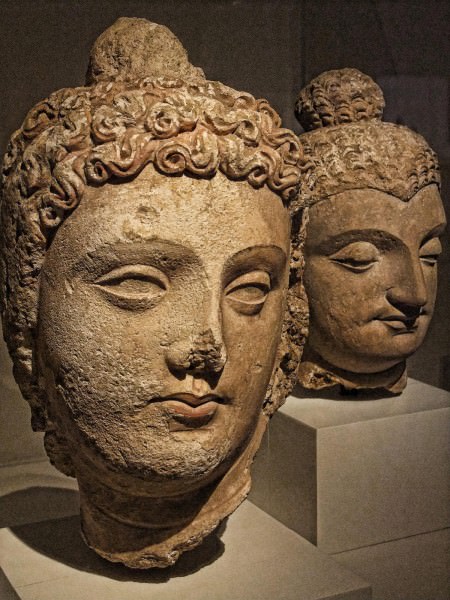
Persia held dominance in northern India until the conquest of Alexander the Great in 327 BCE. One year later, Alexander had defeated the Achaemenid Empire and firmly conquered the Indian subcontinent. Again, foreign influences were brought to bear on the region giving rise to the Greco-Buddhist culture which impacted all areas of culture in northern India from art to religion to dress. Statues and reliefs from this period depict Buddha, and other figures, as distinctly Hellenic in dress and pose (known as the Gandhara School of Art). Following Alexander’s departure from India, the Maurya Empire (322-185 BCE) rose under the reign of Chandragupta Maurya (322-298) until, by the end of the third century BCE, it ruled over almost all of northern India.
Chandragupta’s son, Bindusara reigned between 298-272 BCE and extended the empire throughout the whole of India. His son was Ashoka the Great (lived 304-232, reigned 269-232 BCE) under whose rule the empire flourished at its height. Eight years into his reign, Ashoka conquered the eastern city-stateof Kalinga which resulted in a death toll numbering over 100,000. Shocked at the destruction and death, Ashoka embraced the teachings of the Buddha and embarked on a systematic programme advocating Buddhist thought and principles. He established many monasteries and gave lavishly to Buddhist communities. His ardent support of Buddhist values eventually caused a strain on the government both financially and politically as even his grandson, Sampadi, heir to the throne, opposed his policies. By the end of Ashoka’s reign the government treasury was severely depleted through his regular religious donations and, after his death, the empire declined rapidly.
The country splintered into many small kingdoms and empires (such as the Kushan Empire) in what has come to be called the Middle Period. This era saw the increase of trade with Rome (which had begun c. 130 BCE) followingAugustus Caesar’s conquest of Egypt in 30 BCE (Egypt had been India’s most constant partner in trade in the past). This was a time of individual and cultural development in the various kingdoms which finally flourished in what is considered the Golden Age of India under the reign of the Gupta Empire (320-550 CE).
The Gupta Empire is thought to have been founded by one Sri Gupta (`Sri’ means `Lord’) who probably ruled between 240-280 CE. As Sri Gupta is thought to have been of the Vaishya(merchant) class, his rise to power in defiance of the caste system is unprecedented. He laid the foundation for the government which would so stabilize India that virtually every aspect of culture reached its height under the reign of the Guptas. Philosophy,literature, science, mathematics, architecture, astronomy, technology, art, engineering, religion, and astronomy, among other fields, all flourished during this period, resulting in some of the greatest of human achievements. ThePuranas of Vyasa were compiled during this period and the famous caves ofAjanta and Ellora, with their elaborate carvings and vaulted rooms, were also begun. Kalidasa the poet and playwright wrote his masterpiece Shakuntala and the Kamasutra was also written, or compiled from earlier works, by Vatsyayana. Varahamihira explored astronomy at the same time as Aryabhatta, the mathematician, made his own discoveries in the field and also recognized the importance of the concept of zero, which he is credited with inventing. As the founder of the Gupta Empire defied orthodox Hindu thought, it is not surprising that the Gupta rulers advocated and propagated Buddhism as the national belief and this is the reason for the plentitude of Buddhist works of art, as opposed to Hindu, at sites such as Ajanta and Ellora.

Comments
Post a Comment